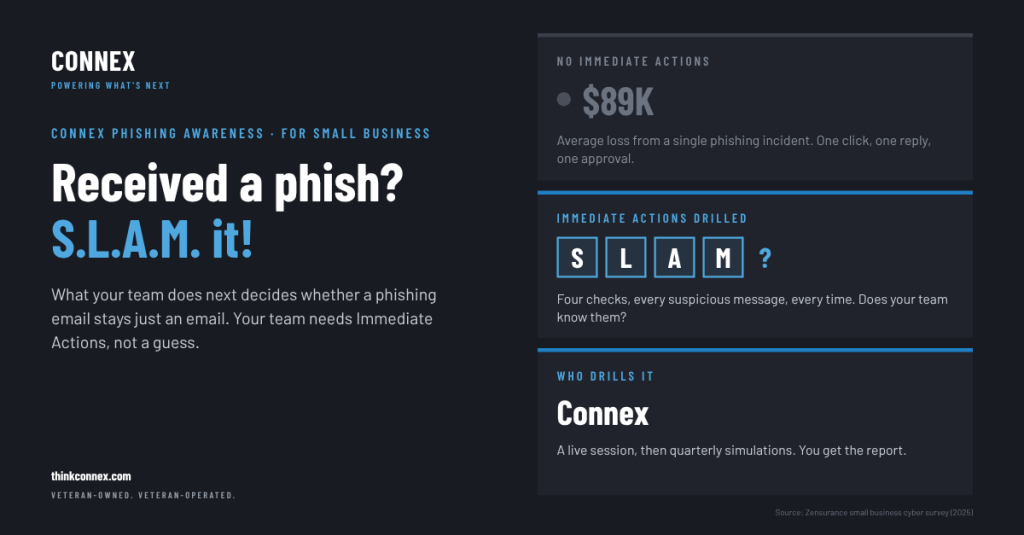
In the army, an Immediate Action (IA) is a drill you practise until it’s automatic. When something goes wrong under pressure, you don’t stop to work it out. You run the drill. Knowing what to do with a phishing email works the same way. The people who handle it well aren’t smarter than everyone else. They’ve rehearsed the first moves.
Most small businesses don’t have that drill. A suspicious email lands and each person improvises. One clicks to see what it is. One replies to ask if it’s real. One forwards it to a coworker, who clicks too. BDC found 61% of Canadian small businesses had already faced a phishing attempt by email, and a 2025 Zensurance survey put the average loss at $89,000 per phishing incident. Few small businesses can absorb that, and BDC found that recovery from a damaging attack often takes more than two months.
What to do with a phishing email: run the drill
Filters catch a lot, but not everything. The message that gets through is the one built to look real: an invoice from a supplier you use, a shared document, a password reset, a quick favour from the boss. Without a drill, the decision gets made in a few seconds by whoever opens it, under whatever pressure they’re under that day. With a drill, everyone runs the same checks, and everyone knows what to do when something doesn’t pass.
Three things to check
- Does everyone run the same checks? If each person has their own way of spotting a phish, you have as many weak points as you have staff.
- Does everyone know who to tell? The fastest stop is one person reporting it before a second person clicks.
- Has anyone practised? A drill you’ve never run isn’t a drill. A simulated phishing email shows who would have clicked, without the real cost.
Received a phish? S.L.A.M. it
We teach a four-step IA called S.L.A.M. It’s short enough to remember under pressure, and it covers the places a phishing message gives itself away. We’re not spelling it out here on purpose. An IA sticks when it’s taught and practised, not skimmed in a post. Your team learns it in the session, takes the pocket card away, and then gets to use it on real-looking emails every quarter.
How Connex Phishing Awareness works
It’s a done-for-you program. We start with a live, instructor-led session of 60 to 90 minutes, tailored to your business and the threats your team actually sees, with a Real or Phish? exercise built from your own suppliers and systems. Then every quarter we send one realistic simulated phishing email. Anyone who clicks lands on a calm teaching page, not a reprimand. You get a plain-language report each quarter showing who clicked, who reported and how risk is trending, plus the completion records insurers ask for at renewal.
What it takes
Start with a free gap test: we run one simulated campaign and share a short, no-blame report. Then we book your live session and handle the quarterly simulations and reporting from there. Every campaign runs only with your written authorization. Packages are a simple annual fee set by headcount, with an annual refresh so new hires are covered.
What to do next
Start with the bigger picture in our earlier Field Note, Too small to be a target? Then download the Phishing Awareness Training brochure (PDF), see the Phishing Awareness service page, or book a Let’s Talk I.T. call and ask for the free gap test.
Sources: BDC, Cyberattacks: Too many risks to ignore (2025); Zensurance small business cyber survey (2025).